Skip to content

Holy Cramp!

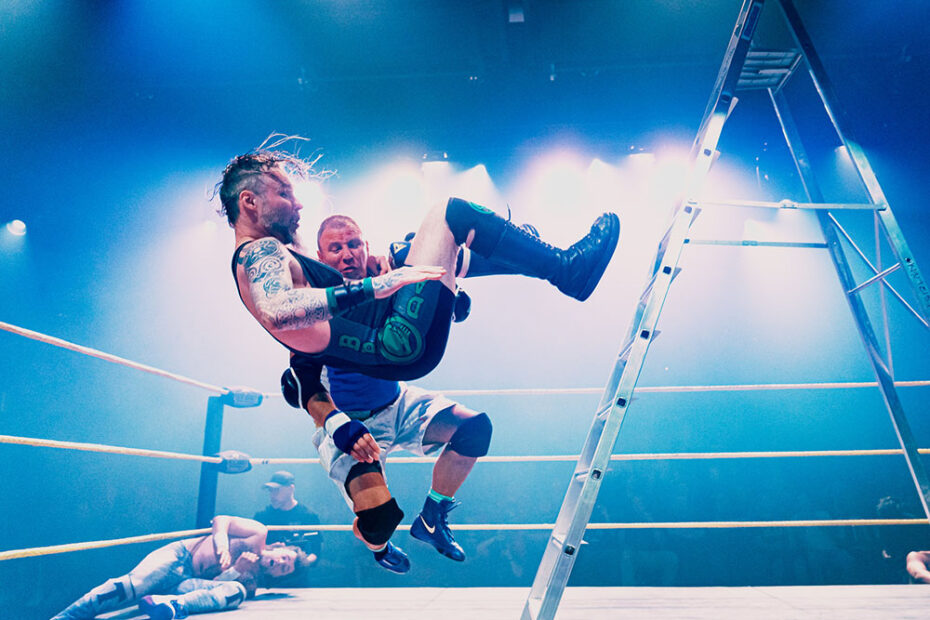
Finnish professional wrestler Miika Forsstrom throws down Canada's The Back Breaker Dylan Broda in a TLC match 2025 (Tables, Ladders & Chairs). Marko Simonen operates at a demanding intersection where the disciplined precision of photography meets the unforgiving physical toll of professional wrestling. In his article "Holy Cramp!", he provides a visceral account of a night when these two worlds collided in a painful display of human limitation. As a seasoned veteran who has spent years navigating the ring as a performer and the ringside as a photographer, Marko understands that the spectacle of a live event is built on a foundation of invisible, exhausting labor. His creative background informs his belief that every match is a story worth documenting. The narrative unfolds during Spring SLAM! in Vantaa, Finland, following a day of intense preparation. Marko’s role in independent wrestling often requires him to function as a "one-man army," building the ring, rigging the lighting, and managing the logistical errands that keep a pro wrestling show running. By the time the main event—a chaotic six-person TLC match—began, the cumulative strain had reached a breaking point. Marko describes the sudden, agonizing onset of muscle cramps in his right leg. In the high-stakes environment of a "Tables, Ladders, and Chairs" match, where the action is fast and the visuals are iconic, the photographer cannot afford to be stationary. Yet, Marko found himself trapped in a physical prison, his muscles seizing even as he fought to maintain his artistic focus. The situation worsened when his left leg also succumbed to the same involuntary tremors. He draws on the "gut it out" mentality of his wrestling background to survive the final ten minutes of the bout. He recognizes that missing a crucial moment, such as the winner grabbing the briefcase, would be a failure of his creative duty to document the wrestling promotion's history. His commitment to the final product overrode his immediate physical distress, proving that the artist’s eye must remain sharp even when the body is failing. Ultimately, the article serves as a pragmatic guide for creators working in physically demanding fields. Marko concludes that the "magic" of pro wrestling photography is heavily dependent on the mundane details of hydration, nutrition, and proper equipment. He reflects on the necessity of salt and electrolytes, turning a moment of physical crisis into a professional lesson on self-preservation. By merging the performative endurance of the ring with the technical demands of the photographic lens, Marko illustrates that creativity is not just an intellectual exercise; it is an athletic one. For him, the ability to tell the story through images depends entirely on the artist’s ability to remain standing when the final bell rings.

I’ve jokingly said sometimes that photography is an upper-body business. But, some days, you’re going to be on your feet all day long. You’d better have good shoes, drink water, and remember to eat. I always have a bottle of water at ringside, but there was one show when it was already too late for that.

Spring SLAM!, May 2025, Vantaa, Finland. Lots to do throughout the day, preparing, taking care of errands, building stuff, etc. The show starts, and all is going well. Until the main event, of course.

It was a TLC match with 6 participants. A special night, a match for the ages. A few minutes into the match, the muscles in my right leg started cramping up and not letting go. There I was at ringside, trying to shake it off, walk it off, stretch my leg, but nothing helps.

I briefly limp back behind the curtain, and “The Rebel” StarBuck hands me a bottle of water. I was losing valuable time, the match was going on, and I knew we really needed those pictures. I head back out to ringside, muscles cramping, biting my teeth.

A couple of minutes later, the situation takes a turn for the worse – the muscles in my left leg start cramping up as well. Holy crap, I never knew something like this was even possible. This was turning out to be a ‘special night’ for sure.

Now, with both legs cramping, I desperately try to focus on the in-ring action and getting the shots. One of our referees at ringside said I was trembling. In my mind, I figured there might be ten more minutes to go. I decided to gut it out and do what I can. I was leaning against the apron, with hopes of relaxing the muscles and stretching a bit.

Dylan Broda finally climbs the ladder, gets the briefcase, and the bell rings. I limp back to the locker room in a hurry and find a seat. I was handed a bottle of Gatorade, for which I’m very grateful. People also brought me water and potato chips for more salt. Slowly, the muscles start relaxing again. For 30-40 minutes, I was afraid to get up from the chair.

I knew I missed some shots due to this bullshit, but I also figured I got most of the important ones. In the end, things like this should absolutely be prevented. Wear comfy shoes, and no matter how busy you might feel, don’t forget to eat and drink plenty of water. And, carry some snacks in your bag.

Take care of yourself.
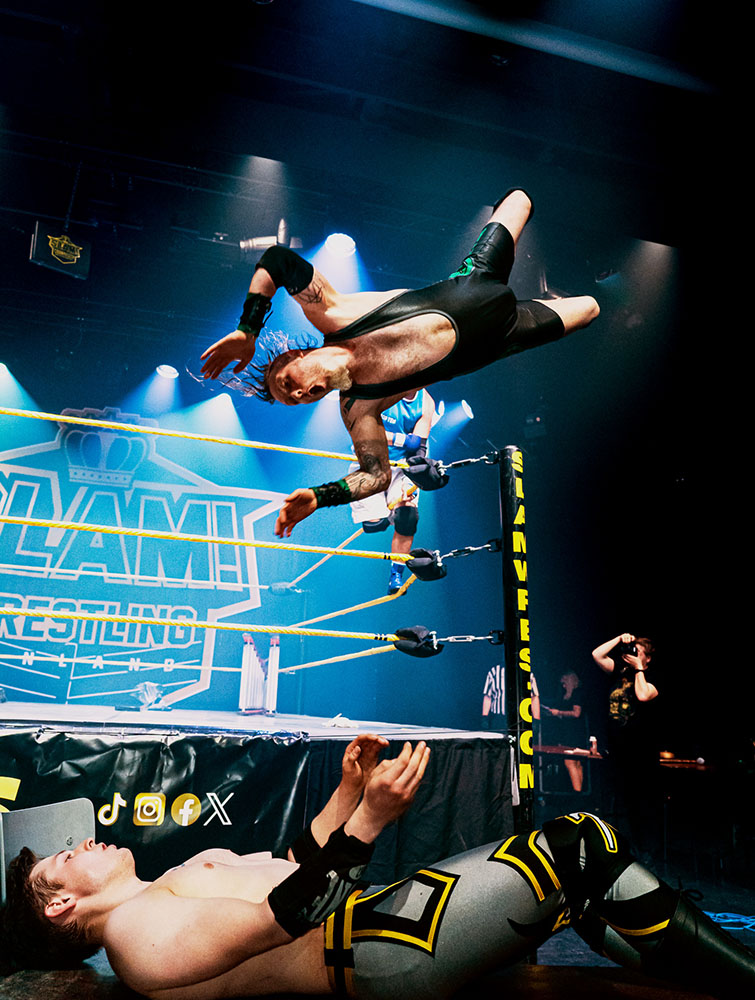
Canadian professional wrestler The Back Breaker Dylan Broda jumps on Estonia's Artur Arder in a TLC match 2025 (Tables, Ladders & Chairs).
Pro wrestling photography requires water, energy, and hydration.

Make sure to hydrate and eat when photographing professional wrestling .