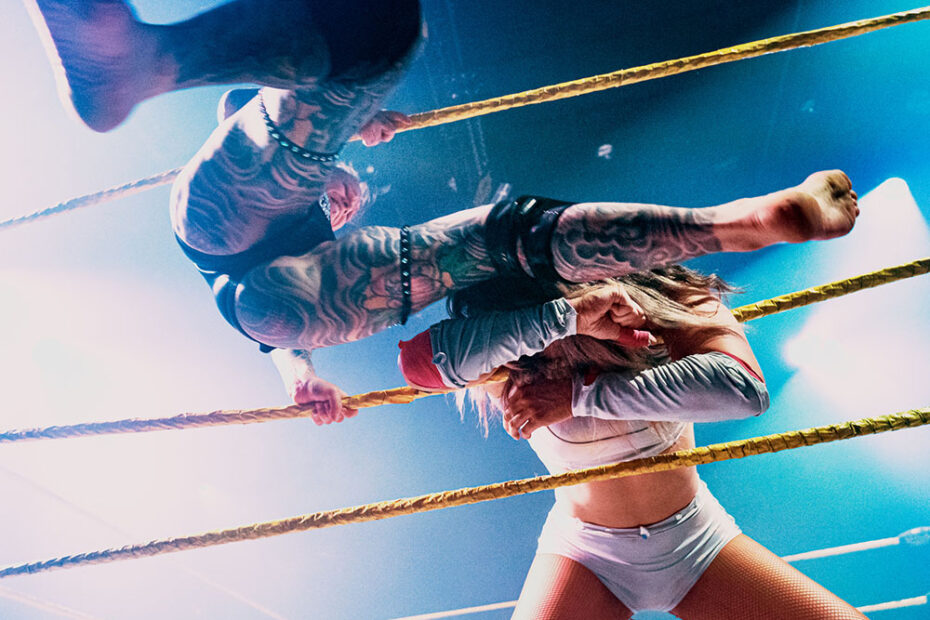
I recall a couple of occasions when a visiting photographer, unfamiliar with pro wrestling, quite literally got squashed like a bug when a wrestler suddenly came over the top rope. I’ve also had lots of close calls myself, and a few good hits.
My personal philosophy about pictures is that I always want to get close. Maybe it’s arrogance, ambition, or overconfidence, call it what you will, but instinctively it becomes a thing of pushing the envelope a bit, just to get some of those dynamic camera angles.
This doesn’t feel invasive with our local talents; they know how I work, and it’s easier to keep myself safe when I know what they do. But, being greedy about my camera angles hasn’t always played in my favour.
During a match between “Back Breaker” Dylan Broda and Big Mikk Vainula, I was reaching in under the bottom rope with my camera when Mikk was about to throw Dylan out of the ring. There was a stumble, it turned into a ‘modified forward roll’, and Dylan’s boot stomped right on the top of my head with full force.
It felt like the vertebrae in my neck got squashed, and I was feeling its effects for the rest of the night. That stupid little hard button on top of my baseball cap dug into my skull like a spike. Happy days.
There was also the time when I had not done my homework on “The Scandinavian Dragon” Aliss Ink, and her 619. Me being the dumbass, I came in close to get a shot of Mila Schmidt on the ropes, and my head was right in the trajectory of Aliss’ leg. She smacked the hat from my head a good 5 feet.
Luckily, it wasn’t anything that ruined her move, and it still looked great. Mostly, I felt embarrassed about it, and learned my lesson. Because the very next night we were in another town and, again, my thick head was in the wrong place at the wrong time. This time, I was quick to duck out of the way, and I can only imagine how funny it must have looked.
One particular move you might want to watch out for is known as the Miz-line. Northern Ireland’s athletic superman, Tucker, is one who likes to do it. If you’re by the corner post with your camera, you better be aware of what’s up. Even though I can react quickly, his foot bumped into the lens hood of my camera. That was a close call.
I’ve also had a couple of close encounters with a steel chair. The first time when I was still refereeing. We had to sneak in to the main entrance early, through the upstairs. The makeshift curtain was in the back corner of the ring, “The Rebel” StarBuck and I were there ahead of time. All of a sudden, a speeding steel chair flung through the curtains and missed us by a couple of feet. We looked at each other and knew we had just dodged a bullet.
Another time when shooting pictures, it might have been a TLC match many years ago. A folded steel chair fell on the side of the apron and bounced high speed straight towards me. Simply reacting to it, I was somehow able to block it with my forearm. The bigger risk could’ve been, however, if the chair had actually hit someone sitting in the front row. So, luckily, it was just me.
At ringside or not, I can have my moments. After a show one time, as I was carrying our camera gear to the car. Two camera bags on my back, a tripod around my neck, and two more bags in my hands. I tripped on my shoe laces like a fool, and it must have looked like a flawless Ric Flair face bump right on the street. Lucky for me and our gear, it was winter time, with some snow to soften my landing.
This time, not learning my lesson at all, I simply got up, grabbed the bags, and neglected to fix my laces. I managed two more steps and tripped again – exactly the same way as before. I fell down like a tree. I’m grateful nobody was there to have a laugh.
“If a photographer falls on the street and no one is around to hear it, does he make a sound?” Well, he does.
Stay safe!