
Skip to content

Photographs? What For?

Professional wrestler Mikk Vainula of Estonia, treating his eye injury backstage after his wrestling match in the ring. In his article "Photographs? What For?", Marko Simonen examines the shifting landscape of visual media through the eyes of both a creative professional and a veteran of the squared circle. He addresses a modern paradox: while the proliferation of high-quality smartphone cameras, stock photo libraries, and AI-generated imagery has made visual content more accessible than ever, it has simultaneously triggered a perceived degradation in the value of the single, captured moment. To Marko, this phenomenon creates a vital distinction between the price of an image and its inherent worth. His background in the arts allows him to see beyond the digital noise, identifying a unique "magic" in the permanence of a still photograph that fleeting videos or generated graphics often fail to replicate. The narrative explores how an image serves as a vessel for storytelling. Drawing on his experience in the wrestling industry—a world built on larger-than-life characters and dramatic physical narratives—Marko argues that a photograph is not just a static record but a text to be "read." He poses a series of internal questions that reflect his artistic discipline: Who is the subject? What are they feeling? How does the light interact with the grit of the setting? For Marko, the composition is a deliberate act of narrative framing. He recognizes that the emotional resonance of a picture is deeply personal, and a viewer’s interpretation might differ from the person standing next to them. This sensitivity to the "vibe" of a shot is what separates a generic snapshot from a piece of art that demands admiration and analysis. Furthermore, Marko highlights the historical weight of his work. Since 2010, he has been meticulously building a photographic archive of professional wrestling in Finland. In this context, the photograph becomes a tool for documentation and preservation. In an industry where matches are often ephemeral and performers come and go, his lens provides a sense of continuity. He suggests that the craft of photography often chooses the individual, rather than the other way around. This vocational pull has led him to capture everything from the intensity of a championship bout to the raw, backstage reality of an injured performer. Ultimately, the article is a defense of the intentional image. Marko concludes that despite the technological shift toward automation and speed, the human element of "showing up" and carefully composing a shot remains irreplaceable. By merging his ring-tested intuition with his creative expertise, he demonstrates that a single, well-timed photograph can document history and stir the soul in a way that no algorithm can match. For him, the value of a photograph lies in its ability to stop time and force the world to look closer at the stories unfolding within the frame.

Over the last many years, it’s felt like a degradation in value with photos and imagery. Smartphones started producing better and better images, free stock photo sites were popping up left and right, and then AI image generation started clearing the table. To many, it might seem like imagery isn’t worth a damn penny.

While all of that is true, and I take advantage of those technologies myself, I do believe there’s tons of value in carefully composed images and documenting important moments. And when I said ‘penny’, we should make a distinction between price and value.

To me, photographs, illustrations, and many paintings have always had this magic of capturing my attention and admiration. There’s something permanent about them. When faced with an interesting piece, you can just watch, admire, analyze, and even ‘read’ an image. I’ve always shared the view that images can tell a story.

Who is in the picture? Where are they? What are they doing, feeling, or going through? How do the surroundings and the setting relate to what’s happening? What are they thinking? What was the photographer thinking? Why did the photographer grab the picture just the way they did? What’s the thought process behind the composition? Why is the light the way it is? What’s the story?
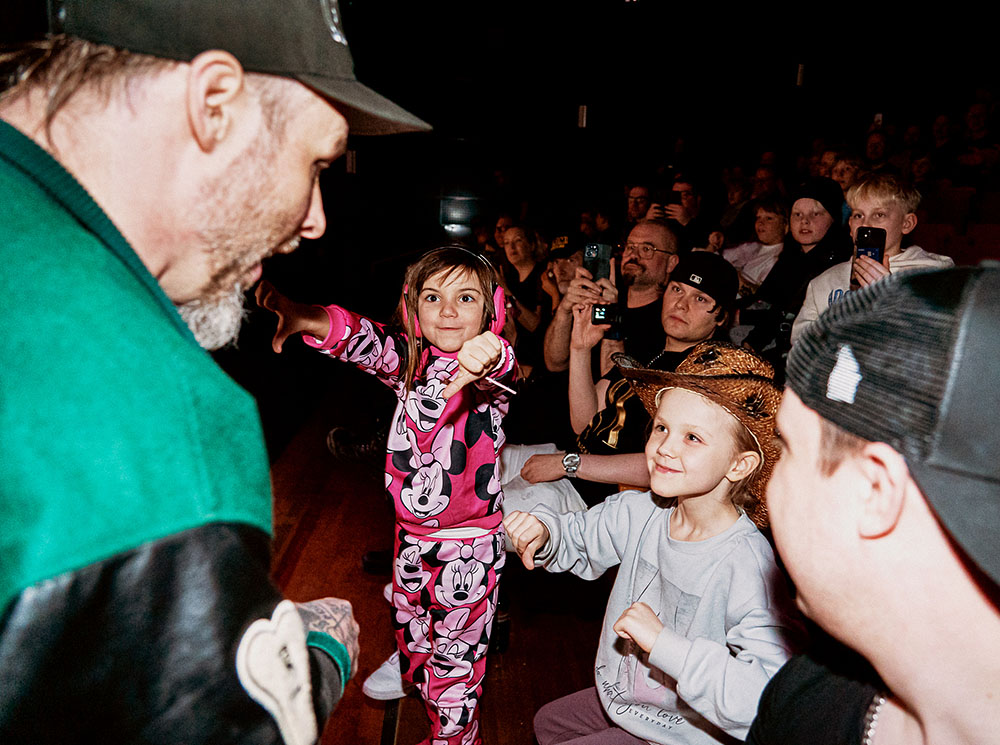
Canadian pro wrestler, The Back Breaker Dylan Broda from Ontario, heckling wrestling fans in the audience, 2025.

Perhaps people tend to interpret pictures a bit differently. The story that’s in your mind might differ from the person next to you. For better or worse, there’s always a level of interpretation.

Sometimes it can just be the colors, or that special something you can’t explain. Call it a vibe, maybe. Still, your fascination and attention is there. Your relationship with an image can be entirely personal. You might have a certain sensitivity to something that’s there.

It’s not that uncommon to hear someone feeling emotional about a picture. Of course, depending on what the topic or their connection to it is. Music, films, or books can have the same effect.

Put all of the above together and it starts to become clear why images can feel incredibly fascinating. At first, I was going to phrase that by saying ‘it starts to make sense’, but decided against it. It doesn’t have to make sense. Most often, it’s the case where you don’t choose your medium or craft. They end up choosing you.

Amale, a French professional wrestler, being intense in her match against Sweden's Aliss Ink, in 2025.
Photos are the best way to document history, in this case the history of professional wrestling in Finland.

A photographic archive of Finnish professional wrestling has been built since 2010.